
Topic 3.5: Sinusoidal Functions
A sinusoidal function is any function that involves additive and multiplicative transformations of the parent sine function, $$f(\theta) = \sin \theta$$. Interestingly, both sine and cosine are considered sinusoidal because they share the same wave shape. In fact, a cosine wave is just a sine wave shifted $$\pi/2$$ units:

The Anatomy of the Wave: Amplitude and Midline
To describe a sinusoidal function, we need to locate its “center” and measure its “height.”
Midline: The horizontal line $$y = k$$ that represents the average value of the function. It is the arithmetic mean of the maximum and minimum values.
Amplitude: The vertical distance from the midline to a peak or a trough. It is always a positive value and represents half the total vertical distance of the wave.

Worked Example: Calculating Characteristics from Extremes
A sinusoidal function has a maximum value of 15 and a minimum value of 3. Determine the equation of the midline and the amplitude.
Solution
Find the Midline: $$y = \displaystyle\frac{15 + 3}{2} = \displaystyle\frac{18}{2} = 9$$.
The midline is $$y = 9$$.
Find the Amplitude: $$A = \displaystyle\frac{15 – 3}{2} = \displaystyle\frac{12}{2} = 6$$.
The amplitude is $$6$$.
Check: Starting at 9, if we go up 6, we hit 15. If we go down 6, we hit 3. Correct!
Period and Frequency: The Reciprocal Relationship
While the Period ($$P$$) tells us how long it takes for one cycle to complete, the Frequency ($$f$$) tells us how many cycles occur over a standard unit of input (usually 1 unit or $$2\pi$$ units).
Period and Frequency are reciprocals:
$$P = \displaystyle\frac{1}{f}$$ and $$f = \displaystyle\frac{1}{P}$$.
For the parent functions $$y = \sin \theta$$ and $$y = \cos \theta$$:
Period = $$2\pi$$
Frequency = $$\displaystyle\frac{1}{2\pi}$$

Worked Example: Period and Frequency
A certain wave completes 5 full cycles every $$\pi$$ units. Find the frequency and the period.
Solution
Find Frequency: Frequency is cycles per unit.
$$f = \displaystyle\frac{5 \text{ cycles}}{\pi \text{ units}} = \displaystyle\frac{5}{\pi}$$.
Find Period: Period is the reciprocal of frequency.
$$P = \displaystyle\frac{1}{f} = \displaystyle\frac{\pi}{5}$$.
Interpretation: It takes $$\pi/5$$ units for one single wave to finish.
Symmetry and Concavity
Sinusoidal functions don’t just go up and down; they “bend” in a specific way.
Concavity: As the graph oscillates, it constantly switches between being concave down (opening downward like a frown) and concave up (opening upward like a smile).
Symmetry:
Sine ($$y = \sin \theta$$): Has rotational symmetry about the origin. It is an odd function:
$$\sin(-\theta) = -\sin(\theta)$$.
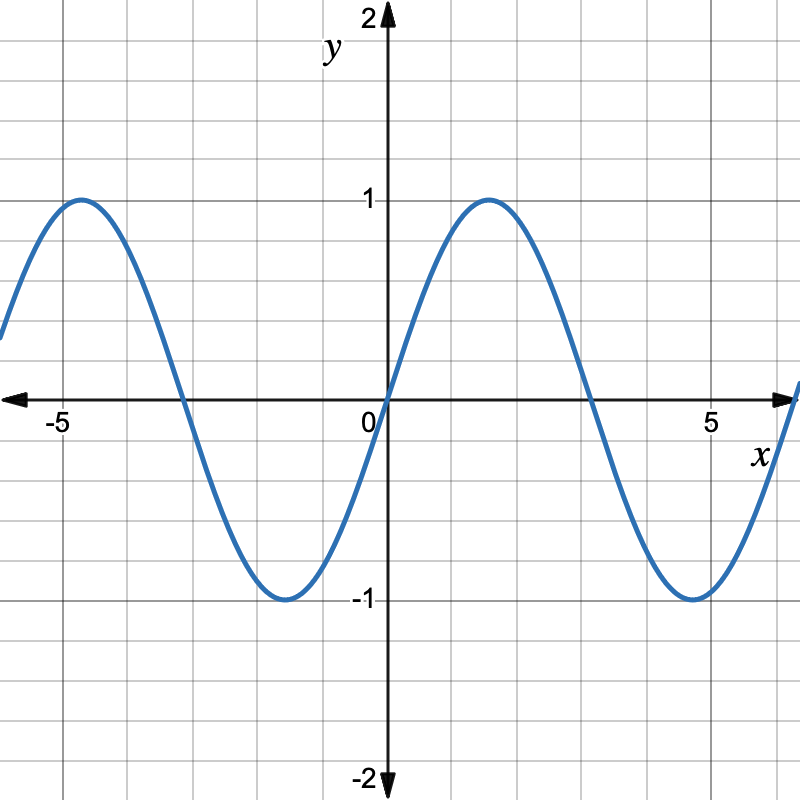
Cosine ($$y = \cos \theta$$): Has reflective symmetry over the $$y$$-axis. It is an even function:
$$\cos(-\theta) = \cos(\theta)$$.

Comparison: Parent Sine vs. Parent Cosine
| Characteristic | $$y = \sin \theta$$ | $$y = \cos \theta$$ |
|---|---|---|
| Midline | $$y = 0$$ | $$y = 0$$ |
| Amplitude | $$1$$ | $$1$$ |
| Symmetry Type | Odd (Origin) | Even ($$y$$-axis) |
| Frequency | $$1/(2\pi)$$ | $$1/(2\pi)$$ |
When analyzing equations like $$y = -3 \sin(x)$$, students often say the amplitude is $$-3$$. Amplitude is a distance, meaning it must be positive. The negative sign represents a reflection, but the amplitude is simply 3.
Worked Example: Using Symmetry
If $$\sin(\theta) = 0.45$$, what is the value of $$\sin(-\theta)$$?
Solution
Sine is an odd function.
Therefore, $$\sin(-\theta) = -\sin(\theta)$$.
Substituting the known value: $$\sin(-\theta) = -0.45$$.
Sinusoidal Family: Includes transformations of both sine and cosine.
Central Tendency: The midline ($$y = average$$) and amplitude ($$height$$).
Reciprocity: Period and Frequency are $$1/f$$ and $$1/P$$ respectively.
Bending: The graph continuously alternates between concave up and concave down.
Parity: Sine is Odd (Origin); Cosine is Even ($$y$$-axis).
Advanced Mastery Assessment (MCQ)
Question 1
A sinusoidal function $$h(t)$$ has a maximum at $$(2, 20)$$ and its next minimum at $$(5, 4)$$. What is the frequency of $$h(t)$$?
(A) $$3$$
(B) $$6$$
(C) $$1/6$$
(D) $$1/3$$
Click for Solution
Step 1: The distance from a max to a min is half a period.
Step 2: $$5 – 2 = 3$$. If half a period is 3, the full period $$P = 6$$.
Step 3: Frequency is the reciprocal of the period. $$f = 1/6$$.
Correct Answer: (C)
Question 2
Which of the following functions is equivalent to $$f(\theta) = cos(\theta)$$?
(A) $$\sin(\theta – \pi/2)$$
(B) $$\sin(\theta + \pi/2)$$
(C) $$-\sin(\theta)$$
(D) $$\cos(-\theta + \pi)$$
Click for Solution
Step 1: Recall the essential knowledge from the text. A cosine wave is a sine wave shifted left by $$\pi/2$$.
Step 2: A left shift is represented by $$(\theta + \pi/2)$$.
Correct Answer: (B)
Question 3
If a sinusoidal function is concave up on the interval $$(a, b)$$, what must be true about the function values on that interval relative to the midline?
(A) The values are always increasing.
(B) The values are always above the midline.
(C) The values are always below the midline.
(D) The values are always decreasing.
Click for Solution
Step 1: Visualize the wave. The “smile” (concave up) part of the wave occurs during the bottom half of the oscillation.
Step 2: The bottom half of the oscillation consists of all values below the midline.
Correct Answer: (C)
If frequency is “cycles per unit,” what happens to the graph of a sound wave if its frequency increases? Does it sound higher-pitched or lower-pitched? How does the period change?