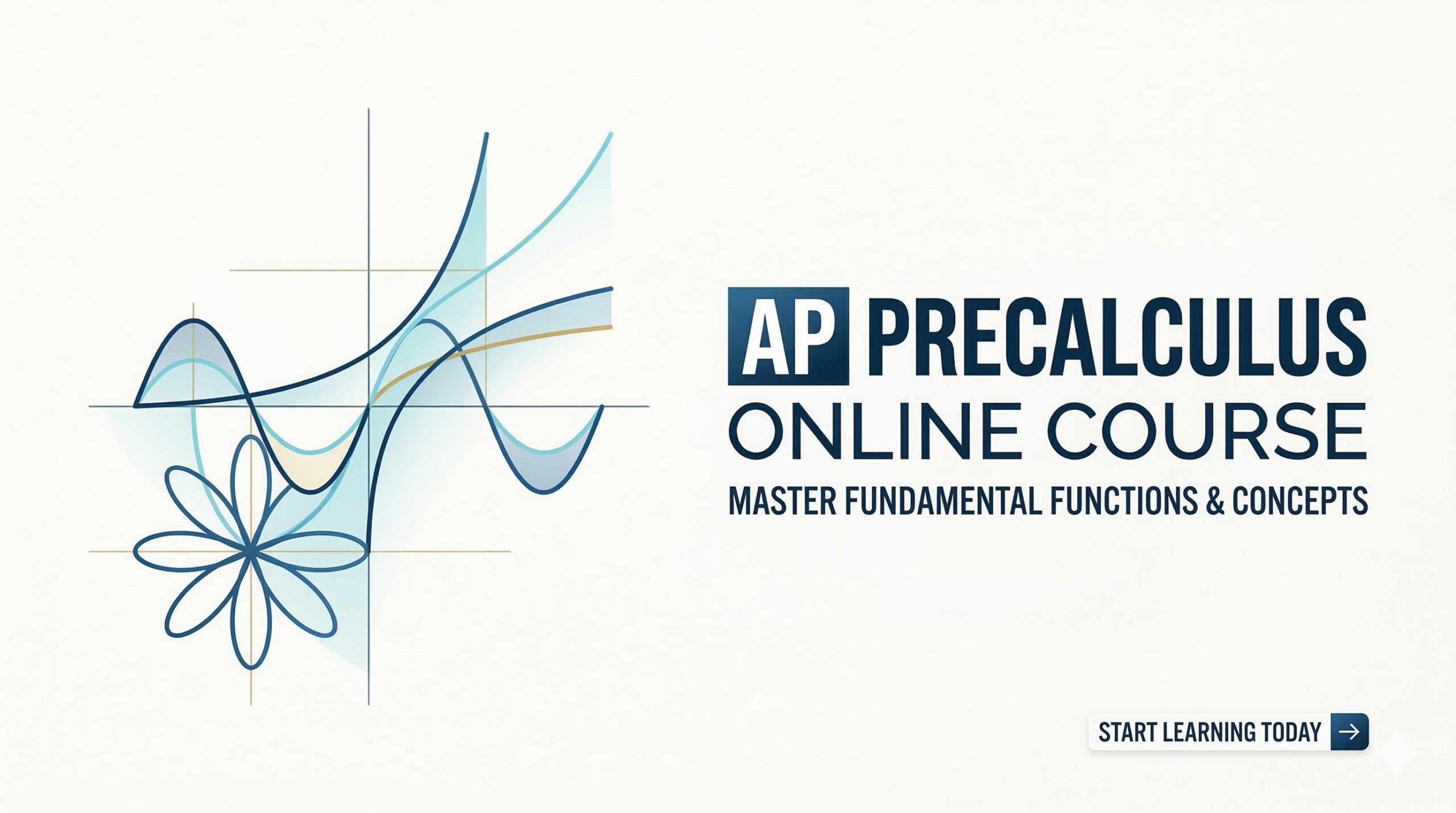
AP Precalculus Masterclass: The Ultimate 5-Point Sprint

About Course
Master AP Precalculus with Confidence
The AP Precalculus exam is more than just a math test; it’s a test of your ability to model the world through functions.
This course is meticulously designed to bridge the gap between classroom theory and exam-day performance.
We focus on the core competencies required by the College Board, ensuring you are prepared for every Polynomial, Trigonometric, and Polar challenge that comes your way.
What’s Inside the Course?
- Comprehensive Lessons: Structured modules that break down complex Unit 1, 2, and 3 topics into digestible segments.
- Detailed Visuals: Every lesson is accompanied by high-quality charts, graphs, and diagrams to help you visualize function behaviors and geometric properties.


- Step-by-Step Examples: We don’t just show the answer; we walk through the logical derivation of every solution, including essential graphing calculator strategies.
- Targeted MCQ Practice: Unit-specific Multiple Choice Questions (MCQs) to help you identify knowledge gaps and master the timing required for the actual exam.
Detailed Syllabus
Module 1: Polynomial and Rational Functions
- Analysis of change in linear and quadratic functions.
- Modeling with Polynomials: Zeros, End Behavior, and Multiplicity.
- Rational Functions: Mastering Vertical, Horizontal, and Slant Asymptotes.
Module 2: Exponential and Logarithmic Functions
- Arithmetic and Geometric Sequences in a functional context.
- Exponential vs. Linear growth rates.
- Logarithmic properties and solving complex equations.
- Data Modeling: Semi-log plots and Regression.
Module 3: Trigonometric and Polar Functions
- Periodic Phenomena: Sine, Cosine, and Tangent transformations.
- The Unit Circle and Trigonometric Identities.
- Polar Coordinates: From rectangular conversion to analyzing polar graphs.
Learning Outcomes
By the end of this course, you will be able to:
- Identify and describe the characteristics of various function families.
- Construct and validate mathematical models based on data sets.
- Solve complex trigonometric and polar equations with speed and accuracy.
- Apply Exam-Day strategies to maximize your score on the MCQ sections.
Note on Updates
Current Status: All core lessons are live. Interactive MCQ Practice sets are being updated daily and will be 100% complete by the second week of April. Enroll now to secure early-bird access to the full question bank.
Course Content
Polynomial and Rational Functions
-
-
-
1.1 | Change in Tandem
-
[Quiz] AP Precalculus 1.1: Change in Tandem
-
1.2 | Rates of Change in Linear and Non-Linear Functions
-
[Quiz] AP Precalculus 1.2: Rates of Change
-
1.3 | Rates of Change in Linear and Quadratic Functions
-
[Quiz] AP Precalculus 1.3: Linear and Quadratic Rates
-
1.4 | Polynomial Functions and Rates of Change
-
[Quiz] AP Precalculus 1.4: Exponential Rates
-
1.5 | Polynomial Functions, Complex Zeros, and Symmetry
-
[Quiz] AP Precalculus 1.5: Polynomials and Complex Zeros
-
1.6 | Polynomial Functions and End Behavior
-
[Quiz] AP Precalculus 1.6: Polynomial End Behavior
-
1.7: Rational Functions and End Behavior
-
[Quiz] AP Precalculus 1.7: Polynomial Rates of Change
-
1.8 | Rational Functions and Zeros
-
[Quiz] AP Precalculus 1.8: Rational Functions and Vertical Asymptotes
-
1.9 | Rational Functions and Vertical Asymptotes
-
[Quiz] AP Precalculus 1.9: Rational Functions and Horizontal Asymptotes
-
1.10 | Rational Functions and Holes
-
[Quiz] AP Precalculus 1.10: Rational Functions and Holes
-
1.11 | Equivalent Representations of Polynomial and Rational Expressions
-
[Quiz] AP Precalculus 1.11: Closeness and Local Linearity
-
1.12 | Transformations of Functions
-
[Quiz] AP Precalculus 1.12: Transformations of Functions
-
1.13 | Function Model Selection and Assumption Articulation
-
[Quiz] AP Precalculus 1.13: Function Inverses
-
1.14 | Function Model Construction and Application
-
[Quiz] AP Precalculus 1.14: Function Compositions
-
Unit 1 Comprehensive Review: Polynomial and Rational Functions
Exponential and Logarithmic Functions
Trigonometric and Polar Functions
Functions Involving Parameters, Vectors, and Matrices (Coming soon!)
Student Ratings & Reviews

No Review Yet